
Shiva Trust's
Shivajirao Pawar Ayurvedic Medical College & Research Center
Pachegaon Road, Pachegaon, Maharashtra 413725
MUHS Code: 123124 | NCISM Code: 0721
Kriya Sharir (Physiology)
Decoding the dynamic functions and physiological processes of the human body, balancing ancient energy doctrines with modern scientific physiology.
Physiology in Ayurveda
Kriya Sharir is the branch of Ayurveda that deals with the physiological functions of the human body. It explains the mechanisms responsible for maintaining health and the changes that occur during disease conditions.
The department integrates Ayurvedic principles with modern physiology to help students understand the functioning of different organ systems. Practical demonstrations and laboratory experiments enable students to observe physiological processes and correlate them with classical Ayurvedic concepts.
Students are trained to understand normal body functions as well as pathological alterations that occur in diseases. This knowledge forms the basis for diagnosis, treatment planning, and preventive healthcare. The department plays a crucial role in developing a scientific understanding of Ayurvedic principles and their application in clinical practice.
Fundamental Biological Concepts
Ayurvedic physiology revolves around key systems and energy constructs responsible for vitality, metabolism, and immunity:
Dosha, Dhatu, Mala
The basic regulatory humours, physical tissues, and waste excretions that define body balance
Agni (Digestive Fire)
The central metabolic force responsible for digestion, assimilation, and transformation processes
Ojas & Prana
Vital energy forces regulating immunity, psychological strength, and respiratory life-force
Practical Training & Laboratories
The department is fully equipped to deliver deep physiological understanding via modern diagnostics and classical experiments:
Physiology Lab Demonstrations
Practical experiments verifying cardiovascular, respiratory, and hematological metrics.
Clinical Correlation Studies
Correlating blood parameters, metabolic rate, and body indexes with Prakriti (body constitution).
Through hands-on training, students develop diagnostic acumen to assess physical equilibrium, plan preventive lifestyle regimens, and formulate early-stage therapeutic interventions.
Department Gallery
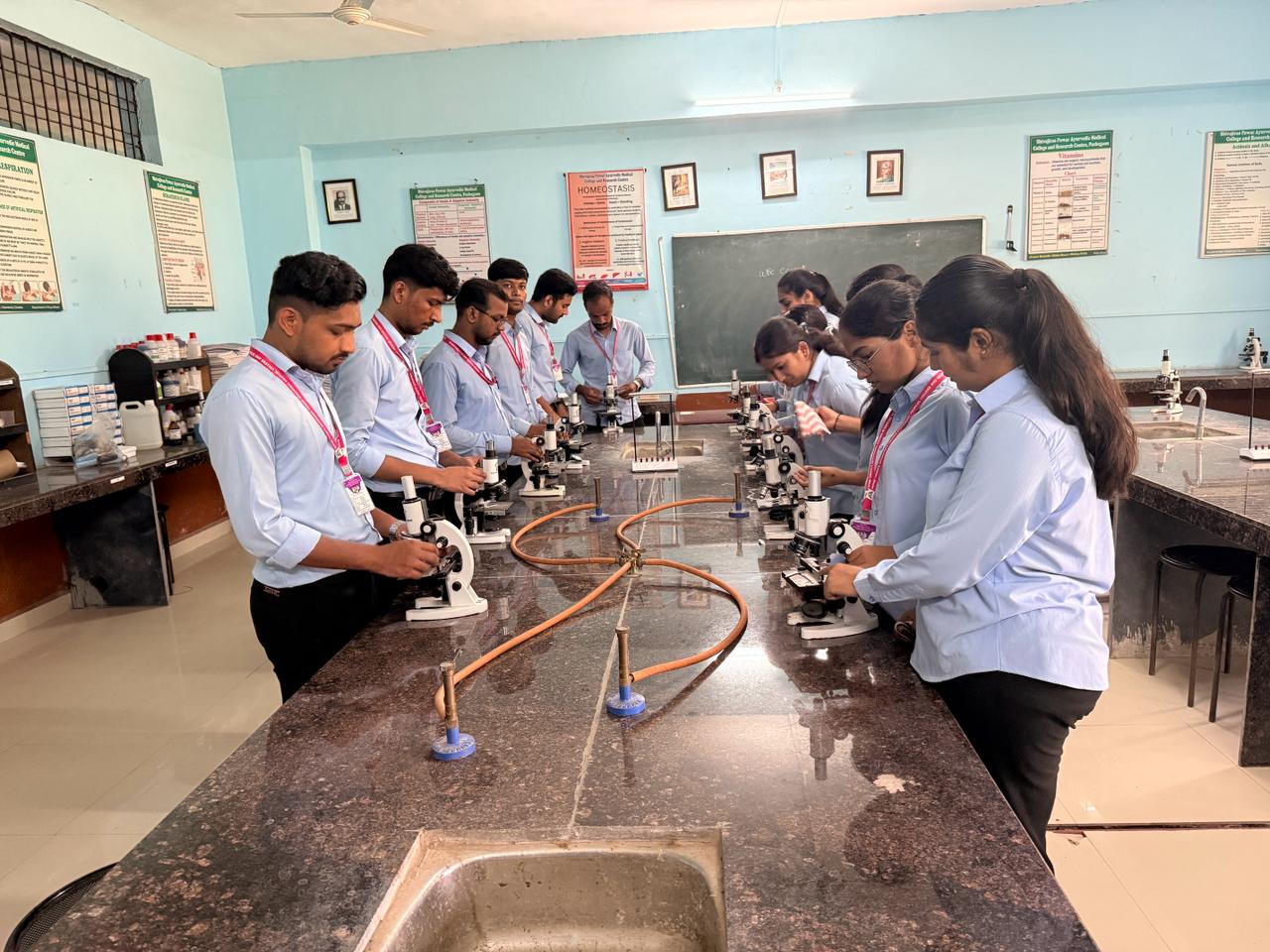
Kriya Sharir Physiology Laboratory
Students conducting biological experiments and physiological tests
Key Learnings & Focus
- Analysis of Prakriti (body constitution type)
- Assessment of Agni (digestive capacity)
- Understanding Ojas (immunity and cellular strength)
- Performing hematological laboratory diagnostics
- Pathological changes correlation for clinical use